
Gynecomastia is a swelling or over-growth of the breast tissue in men or boys. It commonly starts during adolescence or puberty and can persist into adulthood.
Gynecomastia may be present in one or both breasts, and as breasts become larger, they may grow unevenly. It can start as a lump or fatty tissue beneath the nipple, which may be sore.
Gynecomastia is quite common in adolescents, occurring in 4% of boys ages 10 to 19. After the age of 17, the persistence of male breast tissue is unlikely to disappear on its own.
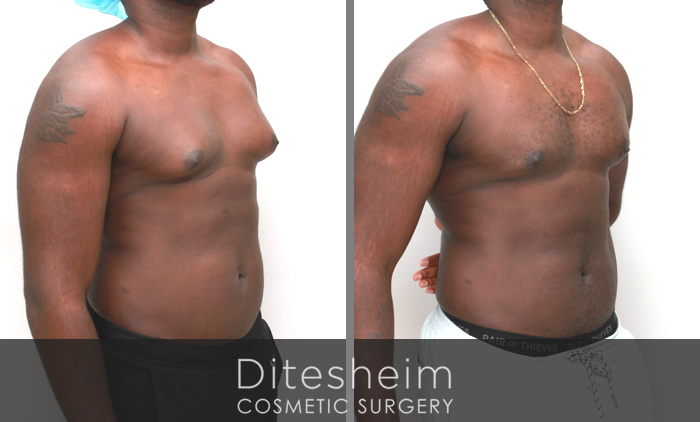
Introductory text for Gynecomastia Grades. Placeholder: Lorem ipsum dolor sit amet, consectetur adipiscing elit. Ut elit tellus, luctus nec ullamcorper mattis, pulvinar dapibus leo.
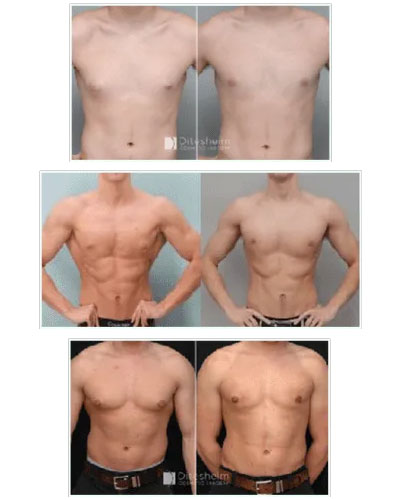
Excess tissue is localized around the areola, causing a “puffy nipple” appearance with a soft-to-the-touch sensation.
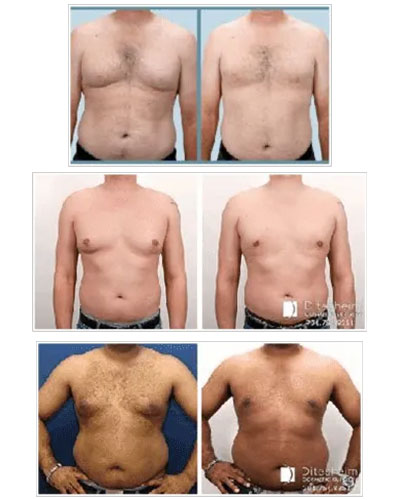
Tissue growth extends beyond the areola and is hard to differentiate between normal chest tissue and excess glandular tissue.
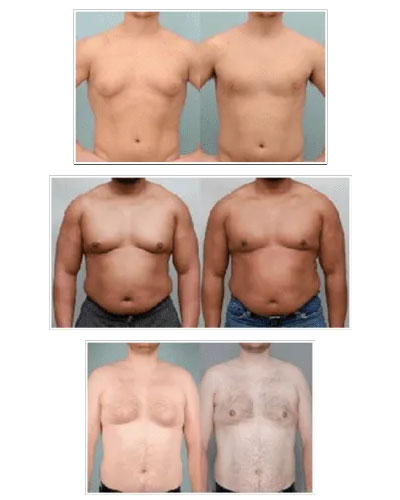
Chest enlargement is greater than grades I and II, with excess skin leading to sagging of the chest. The tissue feels distinctly different than surrounding chest tissue.
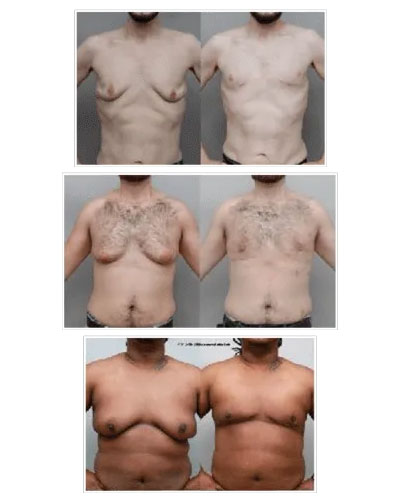
Significant breast enlargement leading to substantial feminization of the chest, often with excess skin leading to sagging tissue below the breast fold.
Gynecomastia is usually benign and is often caused by changes in levels of estrogen and testosterone. However, hormones are often normal in adolescents with gynecomastia. In a study that followed teens with gynecomastia and teens of the same age who did not have gynecomastia over a three-year period, no abnormal hormone levels were found to explain the condition. There was no difference in hormone levels between the groups.
Though very rare in teenaged boys, if hormonal changes are abnormally producing an absolute or relative excess of female hormone, then a search must be done for some abnormality in the body. This search would include an abnormality or tumor of the adrenal gland or testicles or a genetic condition like Klinefelter syndrome.
Gynecomastia can be a side effect of certain medicines, such as antidepressants, antibiotics, chemotherapy, prostate cancer medicines, or ulcer or cardiovascular medicines.
Drugs, such as anabolic steroids, “gym supplements” or “prohormones”, heroin, or marijuana, may also cause gynecomastia.
Some diseases and medical disorders may also cause gynecomastia. These health conditions include liver diseases, kidney disease, lung cancer, testicular cancer, tumors of the adrenal glands or pituitary gland, congenital disorders, thyroid disorders, injury, and obesity.
Overdeveloped male breasts can be a deeply embarrassing condition that causes men and boys to feel ashamed of their bodies. A man or boy with enlarged breasts often socially isolates and avoids normal physical activities due to how his chest appears.
Teens with swollen breasts feel terribly self-conscious, not understanding what is happening to their bodies. Insecurity persisting into adulthood can mean daily camouflage with careful selection of clothes, insecurity in social settings, and even avoidance of intimacy.
Having treated many men and teens with gynecomastia over the last 25 years, Dr. Ditesheim recognizes the decision to have surgery lies with patient himself. By the time a patient consults with a plastic surgeon, he has struggled long enough and is often ready for treatment. The exceptional medical team at Ditesheim Cosmetic Surgery can help restore the masculine contours of the chest and rebuild confidence.
Ditesheim Cosmetic Surgery welcomes consultations for gynecomastia treatment. During the initial consultation with Dr. Ditesheim, he will review medical history, perform an exam, and discuss whether male breast reduction surgery is a safe medical treatment to consider.
The goal of every gynecomastia procedure is the removal of the excess tissue and the restoration of a natural, masculine chest shape. Traditional surgical techniques meant larger incisions, drains, 6 to 8 weeks recovery, and sometimes unnatural chest shape.
Breast tissue under the nipple can be made of fatty, fibrous (firmer), or glandular (hard) tissue. It is hard to predict who will have which type of breast tissue.
For patients whose gynecomastia is mostly excess fatty tissue, Aquashape (water-assisted liposuction) or Vaser (ultrasound-assisted liposuction) can be used to remove the excess fat.
Gynecomastia surgery with liposuction is very efficient in removing fatty tissue under the nipple and over the chest wall.
Often gynecomastia is diagnosed by physicians with past medical history and a physical examination. To eliminate other conditions and diseases, additional tests may be performed including blood tests, urine tests, X-ray, or biopsy.
Most patients with Grade 1 or Grade 2 gynecomastia will not have stitches to be removed. If skin removal is required, there may be a few stitches to remove.
Skin will not be saggy because Dr. Ditesheim determines its elasticity before surgery. Dr. Ditesheim evaluates every patient to create a personalized surgical plan to result in a natural-appearing chest.
A compression garment will need to be worn for three weeks after surgery to minimize swelling.
If there are no complications, patients may vacation one month after the procedure. Scars will be transitioning in the natural healing process but will be strong enough to withstand activities that come with vacation. Scar lines will need to be kept protected from the sun by covering or by applying high SPF sunscreen frequently and liberally. This protection will keep scars on track to being pencil-thin lines when completely healed.
Any breast tissue (fatty, fibrous, or glandular) is removed to create the best masculine chest contour.
The excess tissue that was causing your enlarged breasts will be gone and cannot return. If a patient gains an excessive amount of weight, the remaining fat cells could enlarge and cause gynecomastia again.
There may be a transient loss of nipple sensation immediately after the surgery, but this will correct itself. Dr. Ditesheim uses special techniques to ensure the nerves to your nipples are not severely damaged, but they can be irritated a little from the surgery and not function perfectly for a few days to a week.
Gynecomastia surgery may only require liposuction through a small incision in the armpit.
If glandular tissue needs to be removed, there will be a small scar below your nipple at the areola border or in the natural chest crease. These types of scars are easily hidden.
If excess skin removal is required, Dr. Ditesheim and his patient will discuss scar placement before the procedure.
Dr. Ditesheim prioritizes the best cosmetic results, so incisions are made in places where the scars will fade into natural contours.